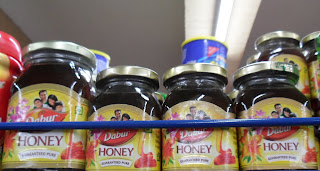
After going through most of the shops selling local brands as well as bigger brands in Ooty, these are the main points that caught my attention:
-Most of the local products like tea, forest oil, honey, spices etc. have very low key/localised packaging.
-That kind of branding/packaging probably works in the local market better, because people identify with them more and they seem more authentic as compared to the the bigger brands.
-But the existing Last Forest packaging fails to gain attention on a shelf beside other bigger honey brands.
-The local market, including the Green shops have regular customers which are locals, but to reach out to the bigger audience which also includes the tourists since they are all situated amongst the hills, Last Forest as a brand has to become louder and more prominent.
-But while doing that, I also have to keep in mind that a large part of the audience is the locals including the communities, and for them to be loyal to the brand and still identify with it, it has to retain their values and identity.
What doesn’t work in the existing branding/ what needs to be included in the new branding:
As a name, Last Forest sounds emotionally strong and appealing, but the visual doesn’t convey the same message.
There is so much history, culture, traditional values behind the whole process of honeyhunting, but the existing packaging doesn’t do justice to the story behind it.
The risk factor of honey hunting is not known to many people, it can be a strong point
The entire process from honey hunting to the marketing of bottled honey is done locally, which can be a selling point for locals.
There is a lot of information that can be included, but hierarchy of information has to be paid attention to in order to hold the customer’s attention.
The completely different categories of the target audiences have to be given priority to, it has to expand to getting the tourist’s and bigger brand buying consumers’ attention and at the same time maintain the locals’ trust and confidence. So, it has to change in such a way that both the purposes are served.
Honey God Rangaswami, masaniamma( first harvest is always offered to the god as a ritual), Biscoti climber, beeswax, Livelihood
History Changes or the lack of it in terms of worshipping, cash Crops not being sufficient anymore as means of livelihood, changing role of crops and cash, no change in terms of marriage beliefs( no inter-cast marriages allowed still), the celebration of kumbhadeva on the peak of a hill
Change
1. Community cooking has grown over the years
2. Cross cultural participation has increased
3. Kurumbas as a community are preferred to conduct the ceremonies amongst other communities, so they are really proud of being such an important part of other’s lives
4. Land has changed as well as the land use pattern because of the extensive tea plantation
5. Before , they always used to have grains/millets at home for domestic use, now even though they sell crash crops to acquire provisions, its not sufficient because of the ever increasing rates of things in the regular economy
6. Before, there wasn’t any fertilizer in the food, now even if they give money and buy food, it has chemicals
7. Forest cover has changed due to rapid deforestation and tea plantation, it has caused migration of bees and other major changes in their lifestyle because they are basically forest people and their lives are intertwined with the forest and its produce.
-instant cash is not really that useful, since everything is so expensive
-Even though they are really attached to their old lifestyle, now wildlife conflict is really difficult to deal with
-Movement/ travelling has increased outside the forest
- use of new technology like mobile phones and television which has made their lives convenient( they also realize the pros and cons of new age technology)
Keystone
-Their intervention has not only helped them with their livelihood by providing them regular wages, and new ways of sustaining themselves but also helped them revive their own history which they were slowly losing touch with
-They helped them see the use of beeswax and produce various by products with it which they used to go to waste before that
-revival of traditional culture is one of the biggest contributions ( *helped them regain their confidence in their culture and construct their own identities out of the traditional values)
Money
-Only enough to sustain their basic needs( which is not sufficient like any of us
-If they had more than that , they would invest in their fields
-Send kids to better schools, than the govt. Provided (realize the importance of good education)
-Invest in personal/household objects
It has brought about a change which they like
There is a contradiction here, some of them feel like they were happier earlier, when they were just living off the forest, with introduction of money in their lives , it has made their life more difficult, while some of them feel that it has brought about changes which were needed and those changes make them happy and their lives more convenient. A shift in mindset can be seen.
Insights
They go through major risks to just obtain the honey, depending on their beliefs and traditions.
The process is really systematic and each person has a role to play.
Their lives revolve around the forest, and their beliefs, honey is everything to them.
They are seemingly comfortable with the transition in their lifestyle.
The resources are not enough.
In the effort to provide them with resources and employment, the government has changed the entire land use pattern, and the forest cover which is having major implications on their lifestyle and the forest which is intertwined.
Because the government provides them with a daily wage to work in the tea plantations, they prefer doing that than actually carrying out their traditional practice of honey hunting, because the government job gives them more security. As a result, slowly their traditional practices are being
forgotten. Keystone is trying its best to help them retain their identity which is attached to those forests and its produce and their traditional practices using different methods.
Marketing their forest produce which is locally processed as well is just one step towards providing them with a means to sustain their cultural identity as well as their livelihood.
How much change is good? If they want to let go of their cultural identity and merge with the rest of us, is that okay? Is convenience the only reason or lack of resources the major reason for their need to change? Is it fair to provide them with a means of livelihood which makes them forget their culture in place of nothing?
The visit to the Documentation Centre was also quite useful. I went there in order to find out about work done by other artists in that area, to get a different perspective than mine. It is a place of historical significance set up in 1819 by John Sullivan, collector of then Coimbatore, an English civil servant whose name is intimately associated with the early growth of the Nilgiris.
I went through some useful books, and also saw really old pictures of all the tribal groups in the Nilgiris which gave me an idea of the changes that have come about in their lifestyle. I also came across some paintings of the Nilgiris and the indigenous people.
It is located in a village called Hasanur which is close to Coimbatore. It is mainy inhabited by the Irulas. The Centre itslef is run by 7-12 locals. They have a shop also which caters to locals. They produce different kinds of honey, spices, beeswax balm, candy and pickles.
First part of the workshop
Number of people who participated- 7
I gave them all A4 sheets and pencils/pens and asked them to draw their perspective of the forest. I don’t know how successful I was in getting my point across to the person translating for me, and then how much of that, they understood. I told them it should be as personal as possible. The point of this exercise was, firstly to get them a little comfortable around me and vice-versa, and most importantly, to understand their perspective of “identity”. The closest association I could think of, was the forest because their lives are so intertwined with it. I wanted to see how they associate with it and in what ways the drastic change in their lifestyles have affected their thinking.
Initially , they seemed very hesitant about drawing, but I tried telling them that it doesn’t necessarily have to be pretty, but more personal. Again, I am not sure if they got that point.
Second part of the workshop
Number of people who participated- 6
The next exercise was story-telling, I asked them to relate any mythical/historical/personal tales which they remember. Not all of them spoke, and also, since it was evening they had started to get restless to go home. Whatever I understood from those broken stories was that all their stories mostly revolve around the forest and honey, that is what they think of as their life. I am not sure if that can be termed as an identity. But their lives have been interwoven with nature for so long, that it is difficult to see through the change in their mindset
-Most of the women working there travel 22kms back and forth everyday. But they seemed very innovative and efficient in terms of optimum utilization of the available resource
-They keep trying to come up with new products using forest produce.
-They have a local market as well, and a local organizing head for their village.
-All the people working there(Irula community) seem to be well aware.
-Most of their life and culture revolves around honey hunting, that being there major source of livelihood also.